
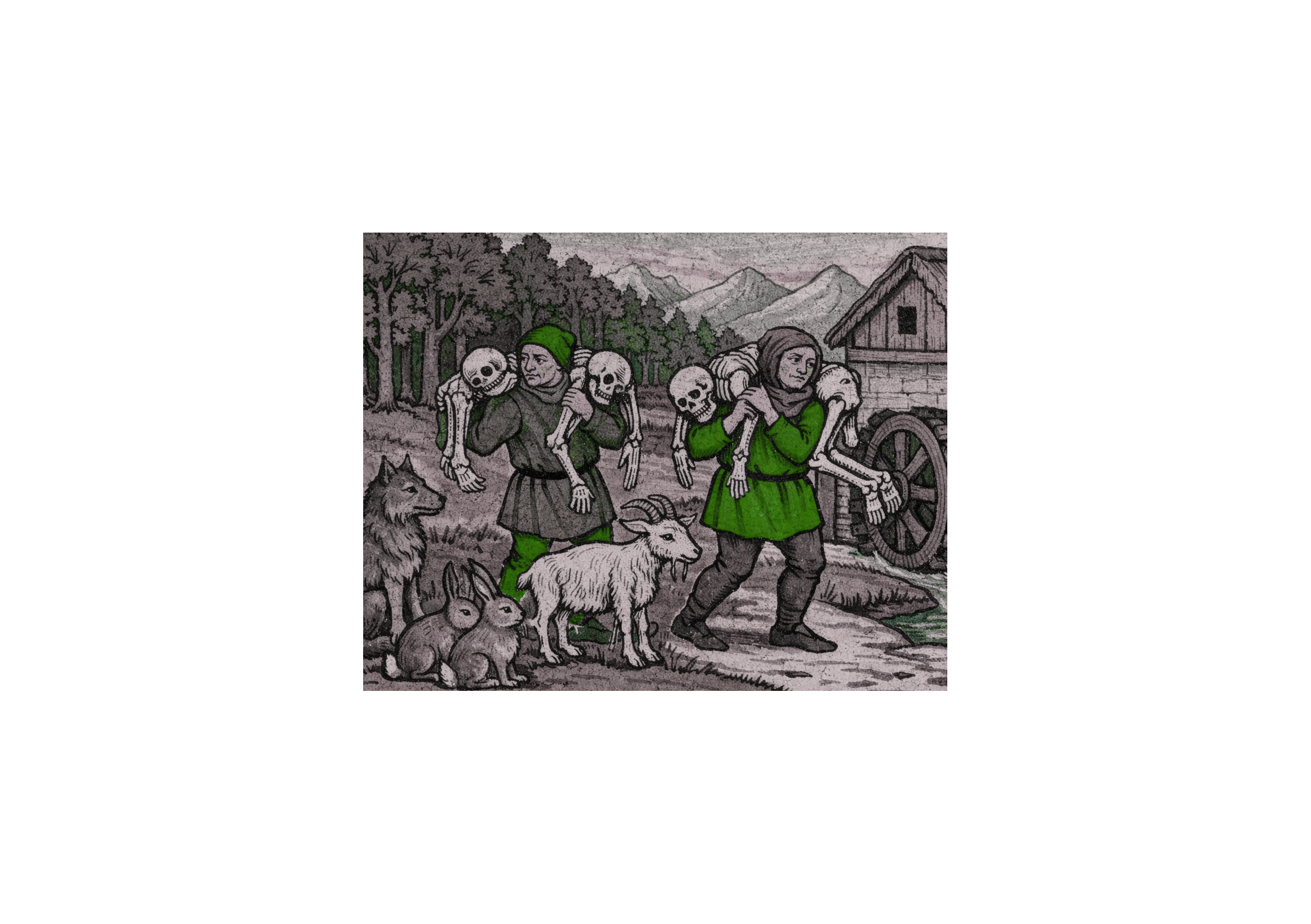
Art and Speciesism: Aesthetics and objectifying frameworks
“Progressive” art that reproduces speciesist hierarchies.
Animal objectification persists in contemporary art and academic discourse, often under the guise of critique, progressivism, or interspecies awareness. While overt exploitation is widely condemned, refined forms—taxidermy, hybridized displays, and aestheticized representations—remain accepted, even within frameworks claiming interspecies consciousness.
The problem is not crude use. It is the epistemic, symbolic, and corporeal transformation of animal existential being into instruments of human reflection. These beings are legible only under human terms, producing a definitorial hierarchy of epistemic blanks: structured zones in which animal agency, relational presence, and bodily integrity are erased or suspended, leaving animals visible solely through human categories.
In the following, “animal being” is used as shorthand for animal existential being.
Conditional Objectification and Epistemic Hierarchy
The structural problem is that animal being is treated as negotiable, not inviolable. Ethical evaluation focuses not on the animal itself but on the human argument: is the work reflective, critical, sensitive? The epistemic center remains human. Animals occupy epistemic blanks: present only to be interpreted, measured, or transformed according to human categories.
Internal speciesism emerges as hierarchically conditioned acceptance. Animals may be acknowledged as victims, yet their relational presence and bodily integrity are never treated as categorical boundaries.
Language, Representation, and Epistemic Mis-Mapping
Language and representation function as instruments of placement and mapping. Animals are located, named, and framed according to human priorities, producing epistemic mis-maps: they are legible only insofar as they fit human categories of meaning, suffering, or aesthetic value.
Representation is not recognition. Trauma, death, or sociality may be acknowledged, but the animal is transformed into a medium: its suffering material for reflection, its body a canvas, its existence a symbol. The authority to define animal experience remains entirely human.
The “We” of Knowledge
Two forms of “we” coexist in human discourse on animals:
- Hierarchical “we” – the compulsory, authoritative collective that speaks for, judges, and maps animality according to human norms. It produces definitorial hierarchies, reproducing speciesist assumptions. Animals are positioned as epistemic blanks: gaps in understanding are treated as inherent rather than as opportunities to rethink frameworks.
- Dialogical “we” – a provisional, reflective space capable of noticing absences, silences, and gaps—where animal being and bodily integrity remain unaccounted for. This “we” participates in recalibrating categories, context, and relational understanding without prescriptive authority.
Even progressive discourse can reproduce hierarchy when the hierarchical “we” appears gentle—acknowledging suffering, framing it critically, or celebrating aestheticized critique—yet retains authority to define what counts as animal experience.
Beyond Aesthetic Management
Animal inviolability and the persistence of species hierarchy are not resolved by empathy or reflection alone. The central problem is availability: as long as animal being remains accessible for transformation, even the most reflective art reproduces hierarchy. Liberation or abolition as vocabulary is insufficient. What is required is inviolability: animal being cannot be subject to human authorization, regardless of framing or context.
Illustrative Example: Taxidermy in Contemporary Art
Artists and curators may aestheticize trauma, bodily deformation, or death, transforming animal being into epistemic and symbolic material [1]. Even networks like Minding Animals, which prohibit trivialization, permit conditional use when the human framing is reflective or critical [2]. Objectification persists through conditional acceptance, showing how internal speciesism operates structurally rather than overtly.
Definitorial Hierarchy of Epistemic Blanks
At the core of internal speciesism is the definitorial hierarchy of epistemic blanks:
- Humans define what counts as animal experience; what does not fit existing categories is treated as empty or negligible.
- These blanks are simultaneously epistemic gaps for humans: without recalibrating our conceptual frameworks, we fail to grasp the presence, agency, and relational significance of animal being.
- Recognition requires daring to think beyond hegemonially human-centered epistemologies, developing new terms, categories, and methods to account for animal existence on its own terms.
Toward Conceptual Recalibration
The philosophical and activist task is to address these structural gaps. What is needed is not better representation or refined empathy, but recalibration of fundamental categories: being, agency, context, and relational significance.
- Withdrawal of availability: animal being must no longer be accessible for desubjectifying human symbolic or aesthetic transformation.
- De-authorization: humans must relinquish authority to define, instrument, or map animal presence according to hierarchical standards.
- Recognition of inviolability: animal being must be respected as structurally unassailable.
Until these shifts occur, even the most progressive art or discourse risks reproducing the very hierarchies it claims to oppose.
Conclusion
Internal speciesism often hides behind subtle, reflective, or “gentle” language. Even interspecies-aware discourse can perpetuate hierarchy when animals are treated as epistemic blanks. Structural progress requires:
- Withdrawal of availability of animal being
- Recognition of bodily and existential integrity as inviolable
- Conceptual recalibration beyond hegemonial human-centered frameworks
Only then can animals be recognized as full beings, as themselves, rather than instruments, metaphors, or placeholders within human knowledge systems.
References
[1] See, for example, Jessica Ullrich, The Taxidermy Hybrid, ANTENNAE: The Journal of Nature in Visual Culture 7 (2008): 18–21. Available at: http://johnisaacs.net/press_files/ANTENNAE_7_2008.pdf (accessed 20 February 2026). Ullrich describes taxidermic hybridizations as imaginative and reflective artistic strategies, framing the transformation of animal bodies into hybrid objects as a productive aesthetic and conceptual practice. The animal appears primarily as material for symbolic recombination and epistemic experimentation. This discursive framing exemplifies how objectification can be rationalized through aesthetic and critical language, without addressing the structural question of the animal’s inviolability.
[2] Minding Animals Curatorial Guidelines for Exhibitions (27 Sept 2017). Available at: https://www.mindinganimals.com/wp-content/uploads/2018/05/Minding-Animals-Curatorial-Guidelines-for-Exhibitions-27-Sept-2017.docx.pdf (accessed 20 February 2026). The guidelines emphasize that artworks involving animals should avoid trivialization and should demonstrate ethical reflection and critical intent. However, they do not categorically exclude the use of animal bodies or materials. Instead, permissibility is conditioned upon the nature of the human framing and curatorial justification. This framework exemplifies conditional objectification: the ethical focus remains on the quality of human intention and discourse rather than on establishing the structural inviolability of animal being.
—
rev 20.02.26