
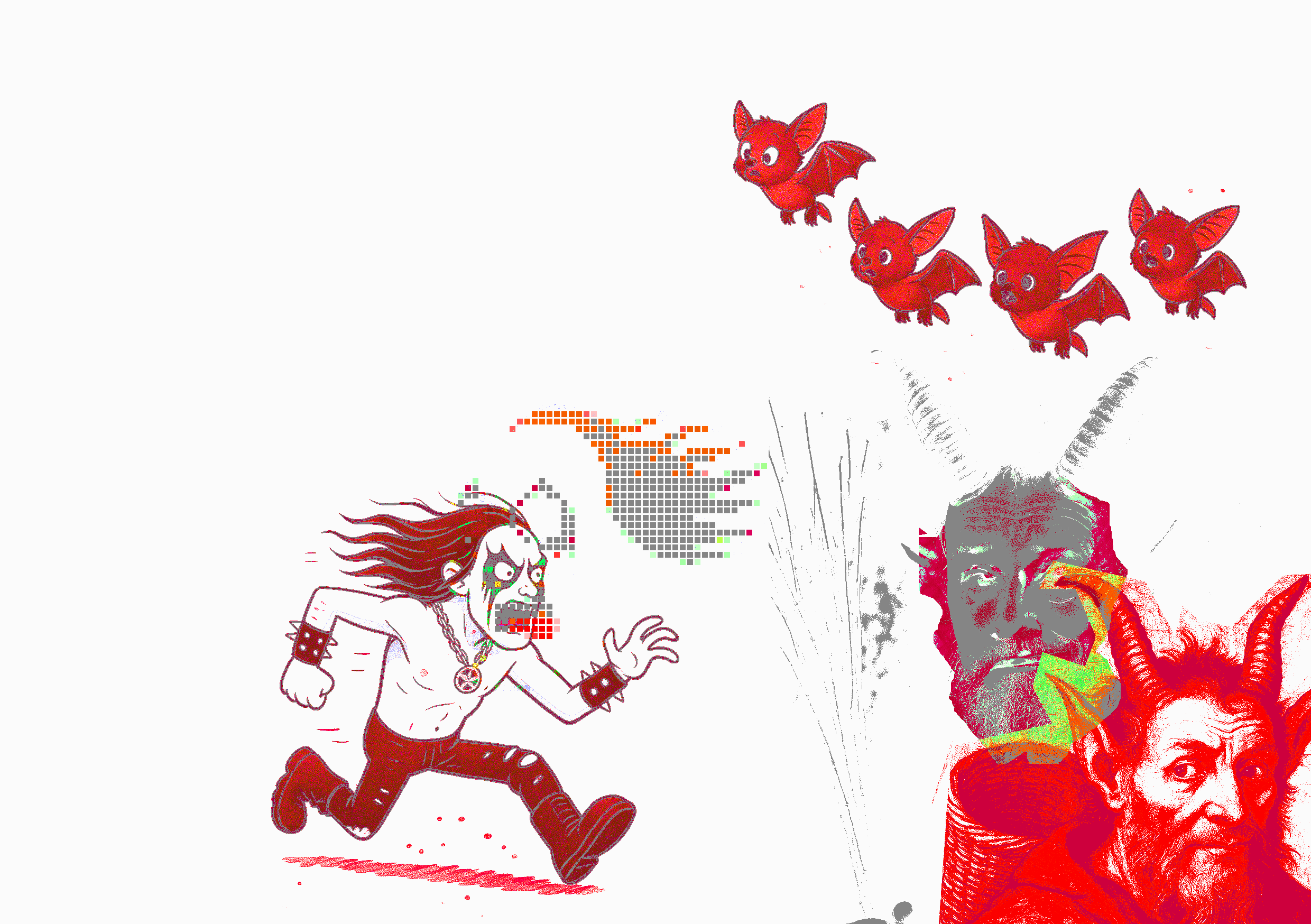
Literary Animal Rights and Punk: Ozzy, a Speciesist Idol
Attempt at a new series: Animal Rights and Punk — Anti-speciesist punk or animal-rights punk in textual form
The universe itself is a footnote to speciesist hubris: the bat
Pay attention to who is undermining antispeciesism with speciesist takes—and how such takes are carried along by others. Right here, as almost everywhere else. The normalizers know exactly how to skillfully normalize their status quo. Grim. Truly grim.
Ozzy Osbourne (as a human being and as a representative phenomenon) and the speciesist-mythological smokescreen of his kingmakers
The universe itself is a footnote to speciesist hubris: the bat
She had wings. She wanted to fly, not to be part of a “legend.”
She knew no stage, no guitar, no performance. She was alive. Her body was small, her senses vast. She lived in frequencies we cannot hear, in spaces we cannot enter.
Humans—blind to everything they cannot name—declare her yet another triviality. A marginal figure in a spectacle that paints its own significance with the blood of those who are marked as different.
In broader contexts of truth, humans appear microscopic next to the depth of nonhuman life. Animals hierarchically categorized by humans as “lower”—such as bats—lead forms of existence that cannot be measured by our limiting concepts of intelligence or dignity. Their lives hold far more meaning and complexity than our language can grasp—or is willing to grasp—simply because they are part of this world. And as part of this real world, regardless of the hierarchies humans invent and enforce, only the laws they themselves seek and create govern them. No human can capture an animal.
What parts of Homo sapiens regard as ignorant, deterministic beings is older, more alert, more finely attuned than our entire moral vocabulary. That humans kill such beings out of calculation is domination. And here, in the case of Ozzy and his fans: a small animal was turned into a symbol on which a human ego was built.
The bat did not die in order to mean something. She died because someone wanted attention. Because many watched. Because everyone went along—and no one stopped it. Her death was not an accident, not an anecdote, not a metaphor. It was an act. And it remains a testimony. Not about her—but about precisely that upon which these kinds of humans build their egos.
Entry for our Speciesist Lexicon:
Bat-killing idol (male, dressed in satanic costume, pseudo-mythical, securing a large following).
Noun — A pop-cultural construct that glorifies speciesist violence under the pretext of youth-coded rebellion. A designation for an archetypal stage figure of late-modern patriarchy whose subcultural aura rests on the calculated destruction of a nonhuman life.
The so-called bat-killing idol stages himself as a boundary-crosser, part shock artist, part spiritually deranged outlaw to whom “the conventions of society” supposedly felt too restrictive—hence his decision to violate physically weaker beings instead, in order to impress an audience that knows perfectly well this is a calculated non-taboo-break, while collectively pretending it is surprising that the majority finds it entertaining.
The bat—central victim and symbol of this fan-community-heroized, collectively fabricated “legend”—was actually killed, in accordance with the program of idol-speciesism that operates through animal bodies, reliably occupying its place among sacrificial nonhuman corpses.
The bat died for the staging of an organic-cultural formation: a speciesist mob coiling itself around a hyped music genre that actively promotes such iconography. The alleged “accident” (myth in fine print, level 1) was supplemented by targeted killing of pigeons and companion animals (myth level 2: “He was just unpredictable”), until the desired overall image of media-compatible sadism emerged—adorned with labels like “legend” or “rock icon.”
Typical features of this idol:
- Wears his pose like a plush crown of thorns.
- Claims to be “against the system” while reproducing its cruelest core assumptions.
- Produces shock instead of change, spectacle instead of substance; numbness as privilege.
- Is loved because he lived—while others had to die for it.
From a queer-feminist perspective, this idol represents one in a series of “special” collectivized male self-empowerments that legitimize themselves through the bodies of others—whether nonhuman animals, non-collaborating human individuals, or forms of difference that oppose speciesism. The pain and suppression of deviation become the stage; the victim itself becomes mere set dressing.
Power remains male-phallically coded—though gesturally variable—supported by compatible femininity-coded elements. The aesthetic is meant to suggest darkness; its obligatory blood symbolism must, for its power rituals, include real blood from injury and the mutilation of an excluded being placed lower in its hierarchies.
Nothing—absolutely nothing—here should be confused with genuine resistance.
Related terms: Satanism as sales strategy, cultural sadism, contempt for animals in rock culture, violence consumption as PR concept. See also: “Rebellion™,” “everyone except certain humans is a marginal figure,” “self-staging that includes killing.”
The admired man who bit off the bat’s head. An animal dies—and the dominant contemporary culture cries: Encore.
An animal dies on a stage. The man who kills it is famous, and here his function becomes visible. His story turns the animal’s death into a decorative footnote—iconic, almost charming. Excentric figures who “lose control,” who are supposed to shock, can market themselves as “uncomfortable court jesters of a conservative era.”
But the animal? A body that trembled. A mouth that bit. An audience that laughed. No punchline. Only an example.
What follows is a hypocritical, half-hearted spectacle of excuses: “He didn’t know. It was just a joke. That’s how things were back then.” And suddenly the stage is clean again. The violence has been “contextualized.” The animal is reinterpreted as an accessory to some human’s madness, as a tragicomic prop. But no one asks what this scene says about us.
Because that one moment—an animal dying because a human wants a legend—is not a slip-up. It is the essence of a cultural industry that feeds on the pain of the Other, as long as that Other does not belong to humans. Look closely enough, and it becomes clear: the scandal was not that an animal appeared at the wrong time in the wrong place—“bad luck if you show up among humans as an animal for any reason.” The scandal was that so many laughed.
What is a rebel who kills cats? What is an outsider who bites pigeons to death for attention? What is a king whose crown is made of carcasses?
They call it “shocking.” But it is only old. The pose of madness, the inverted play with the “satanic”—all of it bears the marks of an order that pretends to be broken while merely re-staging itself. Violence against animals is not transgressive. It is convention.
In cultural Satanism as marketed by Black Sabbath, the animal repeatedly appears: as demon, scapegoat, sacrifice. Satan is animalized—both locked into a reciprocal logic of contempt, twisted into a dominated “power of evil.” The animal becomes the usable accomplice-evil; evil becomes the foreign; the foreign becomes the target.
It is an old, banal magic trick. Humans call themselves moral by demonizing animals. The pointless oscillation between meaningless poles becomes useful for meaningless exercises of power. And whoever publicly elevates themselves over the animal—kills it, mocks it, slaughters it in image and act—becomes the hero of a narrative that disguises itself as counter-narrative but is nothing more than the old story of the supposed right of the stronger, of survival as domination.
These words are not addressed to those who identify with this violence. They are addressed to those who ask why this violence keeps happening under applause. They are for those who sense the difference between genuine rebellion—and the entertainment value of a calculated pseudo-taboo, paid for by those who cannot and will never strike back.
An animal dies. A man becomes rich. And millions call it pop history. We call it what it is: a desperately conservative ritual of domination—an anthro-pathology typical of the 21st century.