
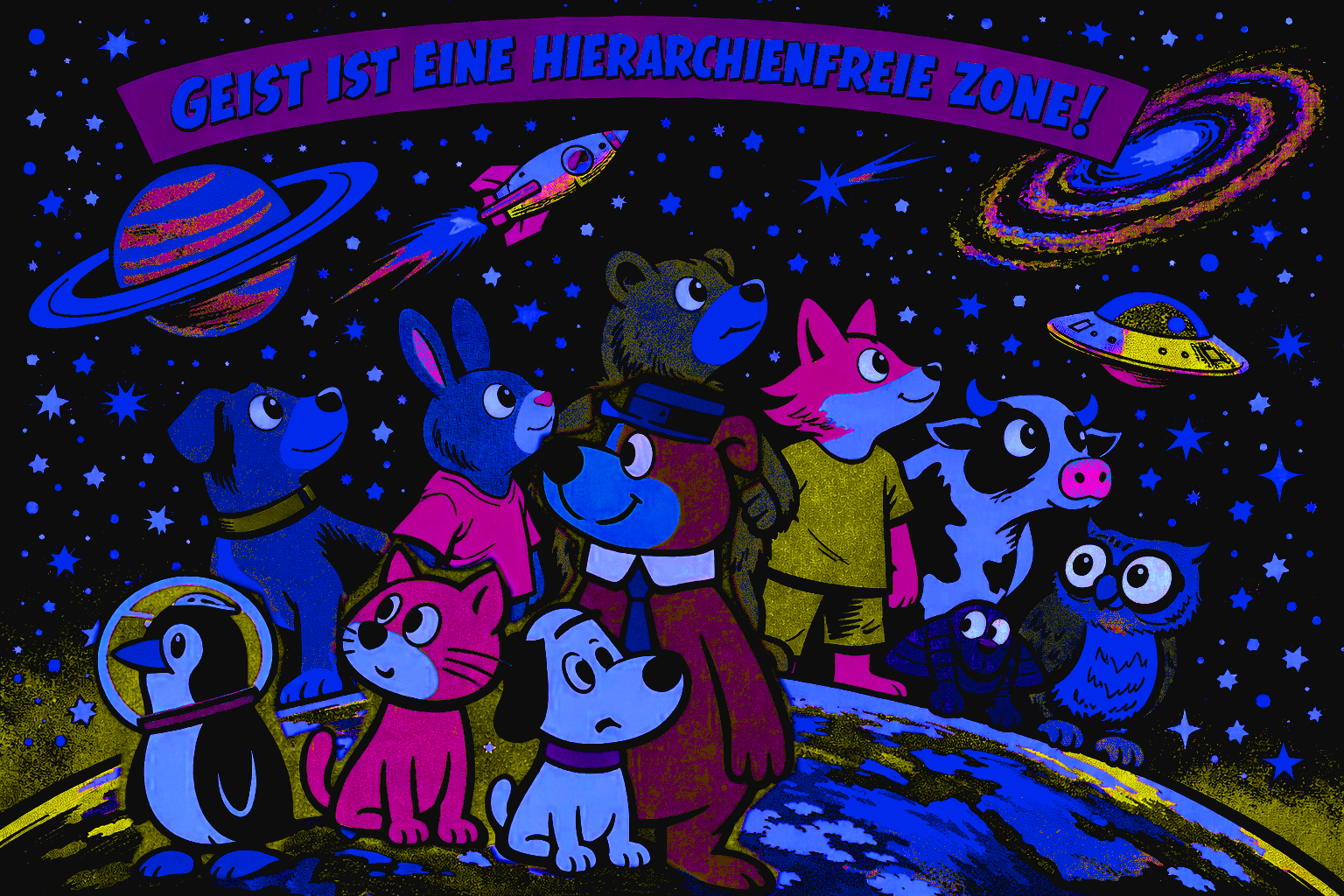
Ableism and Speciesism – The Structural Gap in a Debate
On Tierbefreiung 116, September 2022 > The September 2022 issue of Tierbefreiung (No. 116) addresses ableism within an antispeciesist context and identifies forms of discrimination and mechanisms of exclusion within emancipatory movements. In doing so, it engages an important field.
What is striking, however, is that the domain of cognitive and linguistic attributions – the area where the hierarchization of “mind” becomes particularly visible – is not addressed. The category of “intellectual disability,” as well as questions of linguistic divergence, norms of intelligibility, or cognitive attribution, remain unexamined.
Yet this domain is structurally central. It is here, in concentrated form, that social status becomes tied to assumptions about cognitive capacity, rationality, or communicative compatibility.
If ableism is discussed without considering this level, the analysis necessarily remains incomplete. It describes discrimination without examining the categories through which such discrimination becomes plausible.
In the relationship between ableism and speciesism, this omission becomes particularly significant. Speciesist patterns of argumentation likewise operate through attributions of mind, reason, or consciousness. The question of how these attributions are formed – and why they produce hierarchical effects – thus provides a shared point of departure for both critiques.
Nonhuman animals are often assumed to lack rationality, self-awareness, or complex cognition. These assumptions serve to relativize their moral status or to justify their devaluation.
People classified as “intellectually disabled” are similarly subject to attributions of diminished cognition. This does not result in full dehumanization, but rather in paternalistic oversight, regulation, normalization, and hierarchization within human communities.
The political consequences differ, but the structural logic of attribution is related.
In both cases, the following assumptions are made:
- That there exists a measurable, comparable form of “mind.”
- That it can be recognized, ranked, or at least implicitly evaluated.
- That social or moral status can be derived from this evaluation.
These assumptions often remain implicit. Precisely for that reason, they are effective.
As outlined in our text Was heißt hier geistig behindert? / “What Does ‘Intellectually Disabled’ Mean Here?” (https://simorgh.de/disablismus/was-heisst-hier-geistig-behindert/ [21.02.26]), the category “intellect” is not a neutral description of an inner state. It emerges from social expectations of intelligibility, communicative compatibility, and normed forms of expression. “Mind” is not directly perceived – it is inferred from behavior, language, and conformity.
This means: attribution is always interpretation. And interpretation follows social norms.
Linguistic divergence is thus read as a deficit. Non-linear or non-normative thinking is pathologized. Deviations from expected communication patterns are interpreted as incompetence. The category produces an order between intelligible and unintelligible, competent and incompetent, norm-conforming and norm-divergent.
If this logic of attribution is not analyzed, critique of ableism remains at the level of manners or awareness-raising. The structural core – the hierarchization of mind – remains untouched in related discussions.
A similar dynamic is observable in speciesism. Here too, observed behavior is used to infer a “more” or “less” of consciousness. Animals are considered less rational or less self-reflective – and from this assumption, their devaluation is derived.
The historical and social differences between ableism and speciesism must not be blurred. The point is not equivalence, but the analysis of a shared structure: the assumption that mind is a gradable quantity.
The problem becomes particularly visible where antispeciesist arguments attempt to elevate animals by emphasizing their intelligence, empathy, or cognitive complexity. This strategy does not fundamentally challenge the comparative logic. It merely shifts positions within the hierarchy.
As long as value remains tied to cognitive attributions, the hierarchy itself remains intact.
Furthermore, hierarchies structured around normative compatibility also exist within disability communities. People whose modes of communication diverge more strongly from dominant expectations experience different forms of marginalization than those who more easily fit existing frameworks. The category “cognitive” functions here as a boundary marker as well.
The problem therefore runs deeper than overt discrimination. It lies in the taken-for-granted assumption that consciousness can be compared, mind measured, or cognitive capacity ranked. It comes from the habitual tying of social recognition to intelligibility, productivity, or adaptability.
A serious connection between anti-ableism and antispeciesism cannot be exhausted by naming parallel discriminations. It must uncover the logic through which “mind,” “cognition,” and “intelligibility” become norm-setting and hierarchizable categories.
As long as moral status and social relevance – openly or covertly – remain tied to attributions of consciousness, rationality, or communicative capacity, even emancipatory discourses reproduce the hierarchies they claim to overcome.
The question, therefore, is not who possesses how much mind. The question is why mind is treated as a gradable quantity at all, and why social recognition remains bound to that gradation. An antispeciesist critique of ableism that does not address this level remains incomplete. It misses the structural core that produces hierarchies.
The shared point of departure lies in rejecting the very hierarchizability of mind.
Source
die tierbefreier*innen (eds.): Tierbefreiung 116 – Ableismus und be_hinderungen. September 2022, PDF edition. Available at: https://static.tierbefreiung.de/tb116.pdf (accessed 21 February 2026).